About this dieline
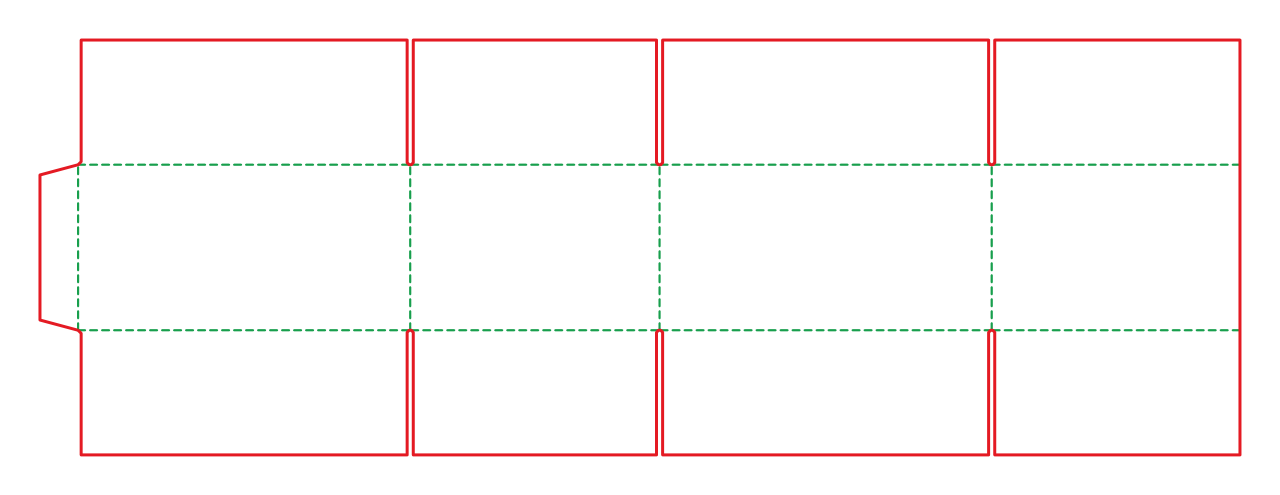
A shipping box is the plain corrugated carton you pack and tape shut: four walls joined by one glued seam, and four flaps at the top and bottom. The two long flaps meet in the middle and close the box. Box makers call it a regular slotted carton, or FEFCO 0201.
Enter the length, width and height and the board thickness, and download a print-ready PDF with cut and crease lines. The flaps are always half the width, so the box is never wider than it is long.
Common stock sizes, length × width × height: about 203 × 152 × 102 mm for a small parcel, 305 × 229 × 152 mm for a stack of books or a pair of shoes, 305 × 305 × 305 mm for a mixed order, and 600 × 400 × 300 mm, which packs four to a layer on a 1200 × 800 mm pallet. Stock lists quote the space inside, so a box made to one of these sizes is a few millimetres bigger outside.
Is the size inside or outside the box?
Crease to crease, the way box makers quote it. The clear space inside is about one board thickness smaller. Check the allowances with your printer, or print one at 1:1 and fold it first.
Which board should I pick?
B flute (about 3 mm) is the usual single-wall shipping board. Go thinner, E flute, for a small printed box; go double wall, B+C, for heavy or large boxes. Only the slots between the flaps change with the board.
Which side is the length?
The longer side of the opening: the two long flaps hinge there and meet in the middle when the box is closed. Width is the shorter side, and height runs from the bottom flaps to the top flaps.
What size box for moving house?
A small moving box, about 416 × 321 × 321 mm, is for books and tools — small and heavy. The medium one, about 460 × 457 × 406 mm, takes kitchen things, toys and clothes. Big, light things like bedding go in a large cube, about 457 mm each way.
Shipping box sizes: stock carton sizes from small parcels to moving boxes →