About this dieline
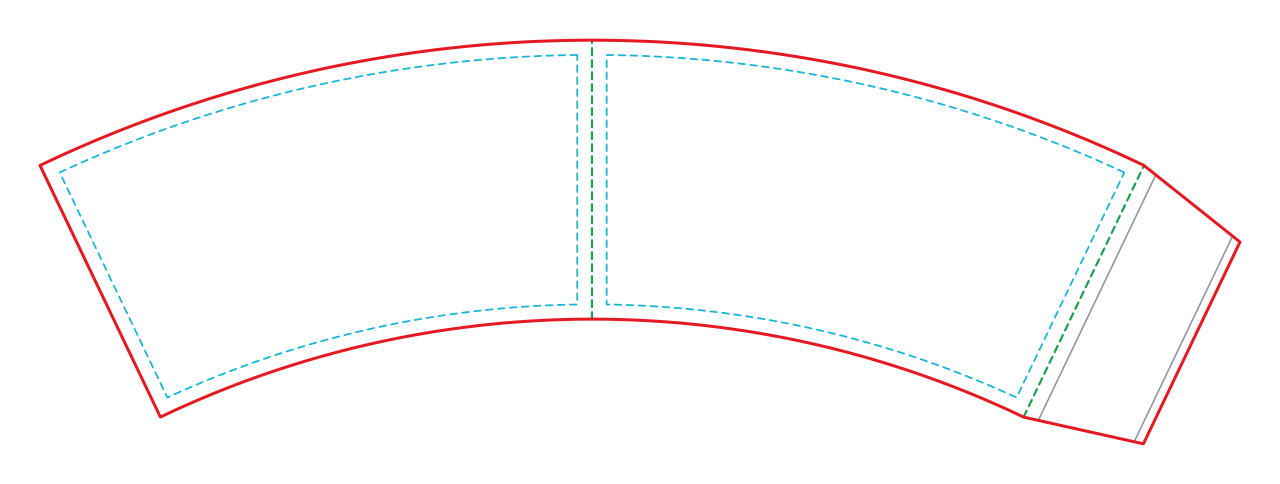
A cup sleeve is the paper band slipped round a takeaway coffee cup: it keeps fingers off the hot wall and gives a café room for its logo. Because the cup is wider at the top, the sleeve is not a rectangle but a curved band — a slice of the cup's cone, unrolled flat.
Enter the cup's top and bottom diameter and its height, then how tall the sleeve is and how far below the rim it sits. You get a PDF at true size with the curved outline, a glue tab on the side you pick, the two folds the glued sleeve lies flat on, and the printable area.
Sizes from one cup maker, top Ø × bottom Ø × height: an 8 oz cup is about 79 × 52 × 94 mm and takes a sleeve 54 mm tall, 25 mm below the rim; a 12 oz cup, 89 × 58 × 108 mm, takes a 60 mm sleeve 35 mm down; and a 20 oz cup, 89 × 63 × 151.5 mm, a 61 mm sleeve 43 mm down. Other brands differ by a few millimetres, and some 12 oz cups have a smaller 80 mm rim, so use your own cup's sizes when you have them.
Where do I find my cup's sizes?
On the cup maker's product page or spec sheet: top (rim) diameter, bottom diameter and height. Or measure a cup: across the rim, across the base and straight up the side from the table to the rim.
Will one sleeve fit several cup sizes?
Often, yes — a sleeve slides down until it grips, so cups with the same rim, like 12, 16 and 20 oz, can share one. This dieline is cut for the cup you enter, so it fits that one best. Print one at 1:1 and try it on a real cup first.
How far below the rim should the sleeve sit?
Far enough to leave room for lips and the lid, and a little above the base. On common cups the sleeve's top edge sits about 25–43 mm below the rim — lower on taller cups.
How wide is the glue tab?
26 mm by default. It is glued under the other end to close the sleeve into a ring; change it if your printer asks for a different overlap, and pick the side it sits on.
Cup sleeve sizes: paper cups from 8 to 20 oz →