
Envelope dieline
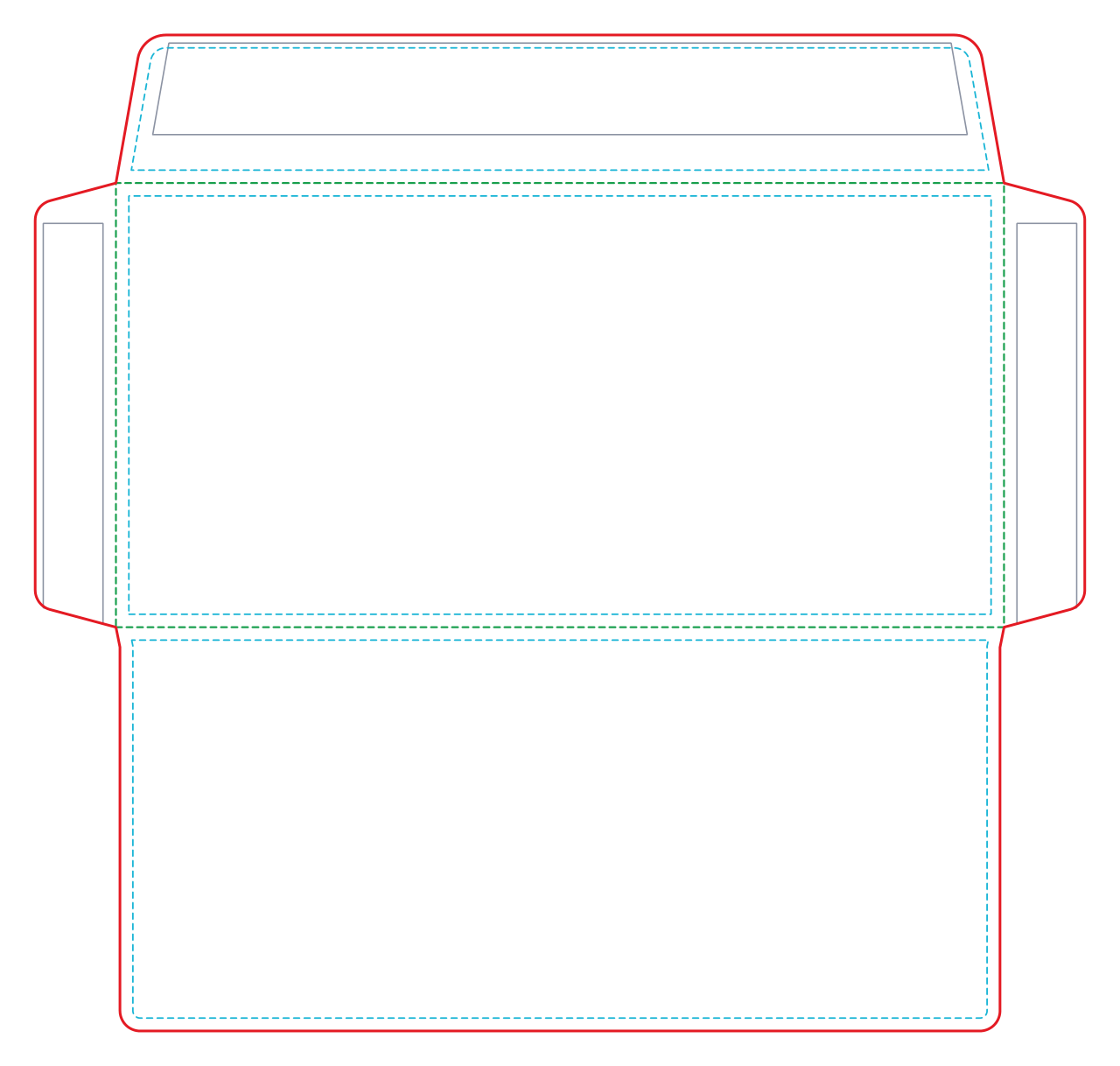
Free envelope dieline template: the classic wallet envelope with side flaps, a glued back and a straight seal flap you glue shut. Enter width and height; get a print-ready PDF with cut and fold lines.
About this dieline
About this dieline
This is the classic letter envelope, the kind you post a folded letter or a card in. One sheet: the front, a narrow flap on each side that folds in, a back that folds up over them and is glued down, and a straight seal flap on the long top edge that you glue shut. For one that closes without glue, see the tuck flap envelope.
Enter the width and height of the finished envelope and download a print-ready PDF at true size with the cut outline, the folds, the glue zones and the printable area. Common sizes, width × height: DL is 220 × 110 mm, for an A4 letter folded in three; C5 is 229 × 162 mm, for A4 folded once; C6 is 162 × 114 mm, for a card; and the US #10 business envelope is 9½ × 4⅛ in (241.3 × 104.8 mm).
How big should the envelope be for my letter or card?
A few millimetres larger than what goes in, on both sides. The standard sizes already allow for it: an A4 letter folded in three fits a DL, a 5 × 7 in card fits an A7 envelope.
Which paper should I use?
Plain office or envelope paper of about 90–120 g/m² folds cleanly and goes through the post. For a heavier card stock, print one at 1:1 and fold it first: thick paper needs a little more room.