About this dieline
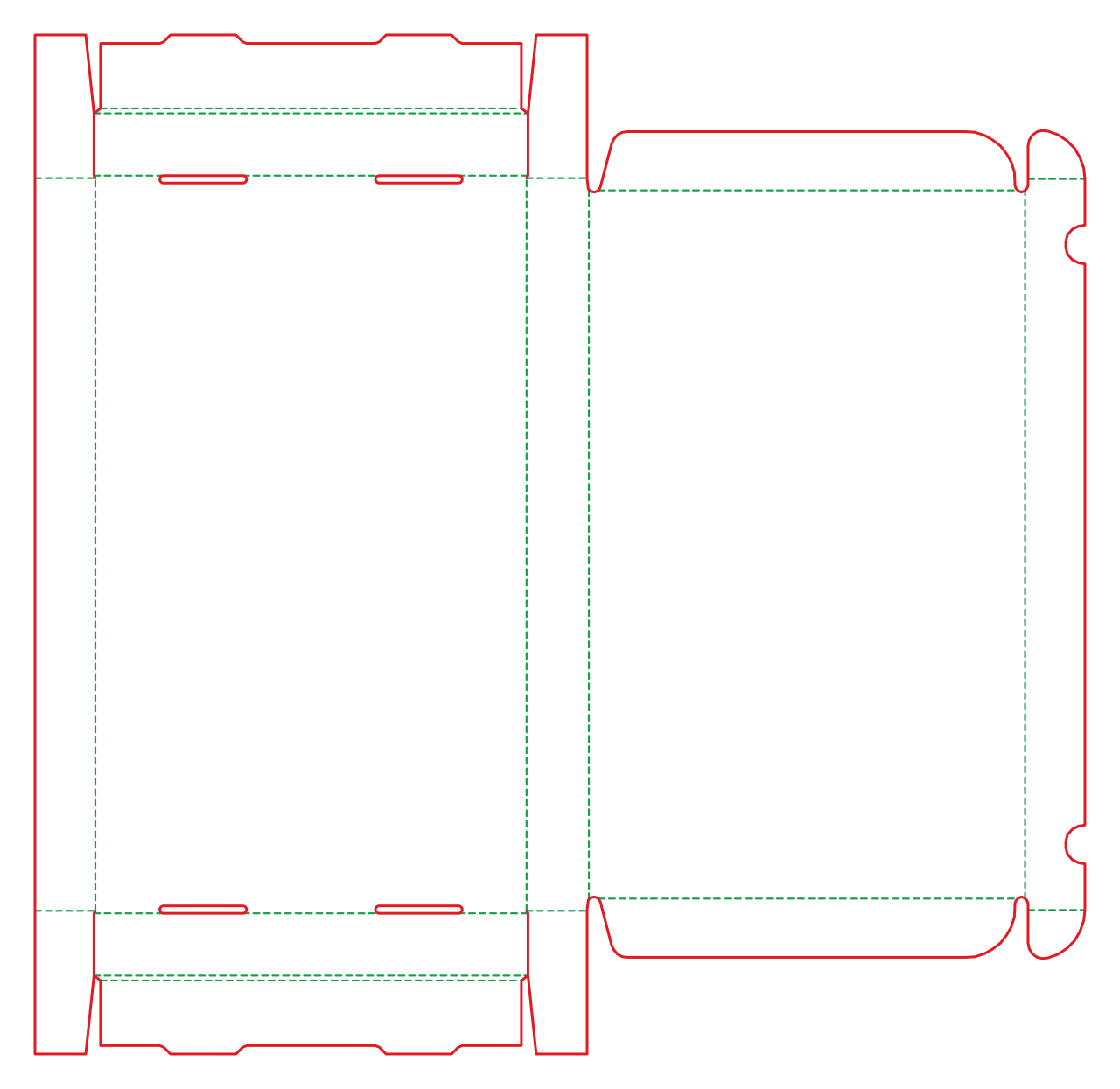
A pizza box is the flat takeaway box every pizzeria uses: one sheet of corrugated board, a lid hinged at the back, and double end walls that lock into the base, with no glue and no tape. It works just as well for cakes, pies, flatbreads and anything else that travels flat.
Enter the size of the box and the board thickness, and download a print-ready PDF with cut and crease lines. Sizes are crease to crease, the way box makers quote them; the board thickness is allowed for only where it matters: the double end walls, the lid and the lock slots.
Sizes to start from, width × depth × height: about 240 × 240 × 42 mm for a 9-inch (23 cm) pizza, 260 × 260 × 42 mm for 10 inches, 355 × 355 × 45 mm for 14 inches, 406 × 406 × 42 mm for a 16-inch family pizza and 457 × 457 × 51 mm for an 18-inch one. Pizza boxes are square, so width and depth match. One pizzeria's large is another's medium, so measure your own pizza before you order.
What size box for my pizza?
A little bigger than the pizza, so the crust doesn't rub the walls: a 12-inch (30 cm) pizza usually goes in a box about 310 × 310 mm. The pizza box sizes guide lists the usual sizes.
How deep should it be?
About 40–50 mm for a regular pizza. Deep-dish or stuffed crust needs 65–75 mm, so the lid doesn't touch the toppings.
Which board is a pizza box made from?
Thin corrugated board. E flute, 1.5 mm, is the default: light and stiff. For an extra-large or heavy pizza pick B flute, 2.8 mm. The box keeps its size; only the double end walls, the lid and the lock slots make room for the board.
How do I fold it?
Fold each end wall up, over and back down inside, and push its small tabs into the slots in the floor; the corner flaps tuck in between the two layers. Then close the lid and tuck its front flap in behind the front wall.
Pizza box sizes: from a 9-inch pizza to an 18-inch family one →