About this dieline
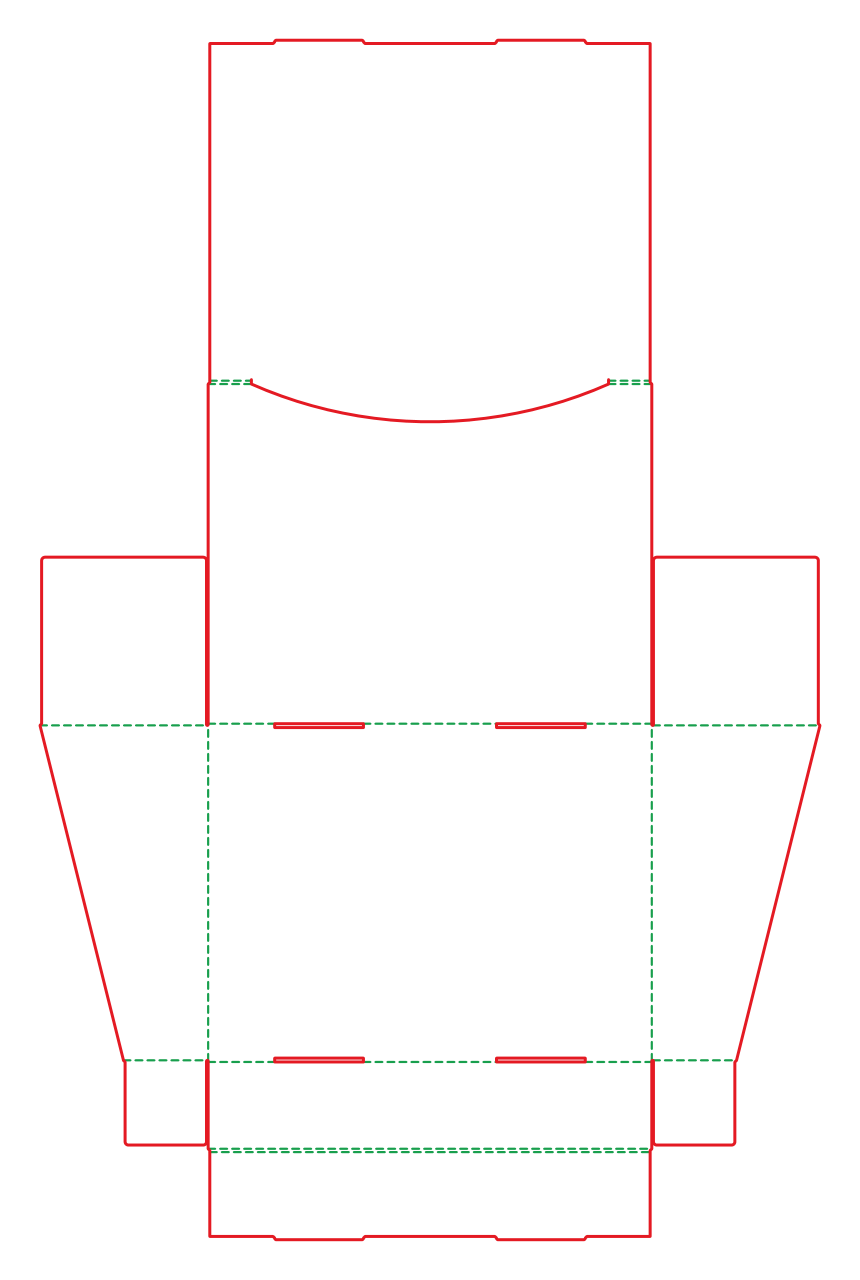
A display box is the open cardboard tray that stands by the till with products in it: a low front lip to reach over, sides that slope up to the back, and a tall header for your brand. One sheet of corrugated board: the front lip and the back fold over double and lock into slots in the floor, and the side walls tuck their flaps inside them, so it needs no glue.
Enter the length, width and height, how tall the header is and how low the front lip sits, and the board, and download a print-ready PDF. An arch along the top of the header stands up above the fold to finish it.
Typical sizes, length × width × height: about 200 × 150 × 100 mm for a small counter tray of lip balm or keyrings, 305 × 152 × 102 mm for a row of small items and 400 × 250 × 150 mm for a bigger mixed range. The stock counter tray found on more than one list is 400 × 305 × 152 mm (15¾ × 12 × 6 in) with a 152 mm header. To measure, lay the products out the way they will stand and take the floor they need, with a few millimetres to spare.
Which side gets my artwork?
The header shoppers see is the panel marked HEADER FRONT: it folds over the top and down inside the back. Put the brand there and on the front lip; the outside of the back faces the shop wall.
Is the size inside or outside the box?
Crease to crease, the way box makers quote it: length along the front, width front to back, height of the sides at the back. The clear space inside is a little smaller. Check the allowances with your printer, or print one at 1:1 and fold it first.
How tall should the header be?
As tall as the sides is a good start: the stock counter tray has a 152 mm header on 152 mm sides. Make it taller for a bigger logo, or set it to 0 to leave the header off.
How low should the front lip be?
Low enough to see and reach the products, high enough to hold them in. Half the height of the sides is a good start; the lip can't be taller than the sides.
Display box sizes: counter display trays with a header →