
Burger box dieline
Free burger box dieline template: the one-piece takeaway clamshell with a hinged lid, corner ears and a tongue that locks it shut, no glue. Enter length, width and height; get a print-ready PDF with cut and crease lines.
About this dieline
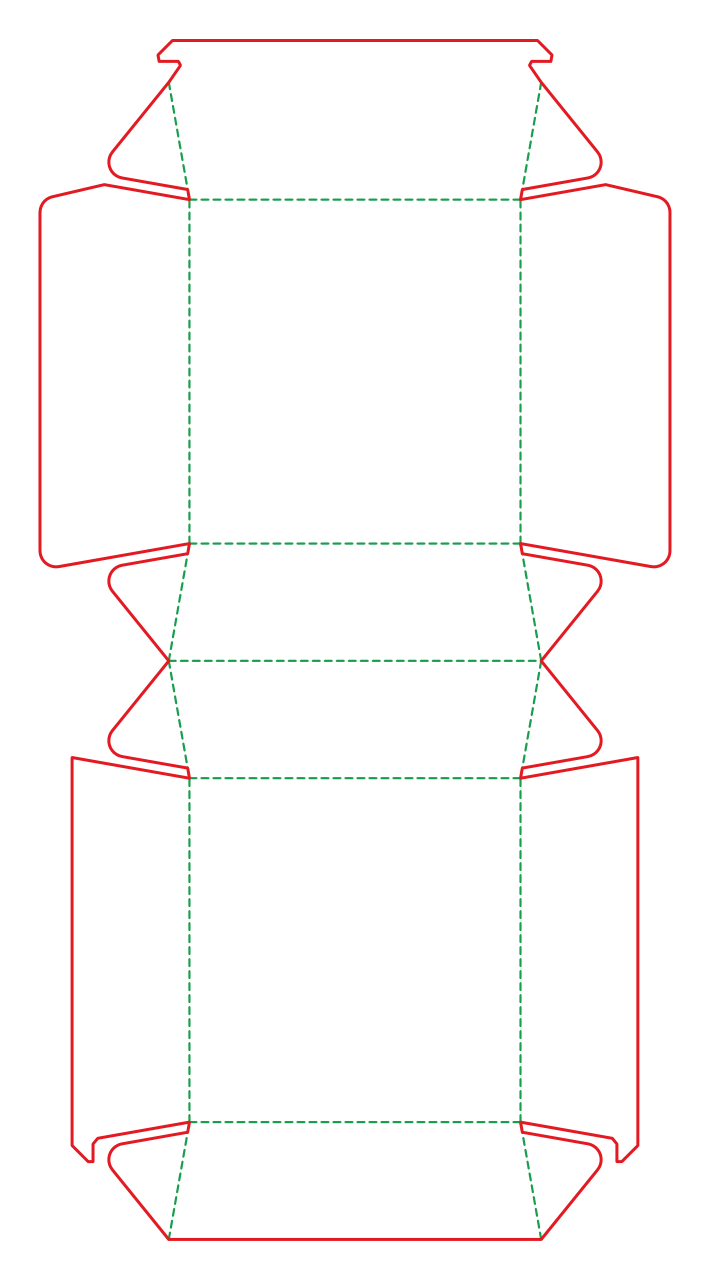
About this dieline
A burger box is the takeaway clamshell a burger comes in: a base and a lid cut from one sheet of board, hinged at the back. The walls lean out a little, so the closed box is widest where the two halves meet. Little ears at the corners fold in onto the side walls, and a tongue on the lid hooks two small teeth on the base to keep it shut. No glue.
Enter the length and width of the base and the closed height, and download a print-ready PDF with cut and crease lines. Typical sizes, length × width × height: about 103 × 107 × 73 mm for a slider or a small burger, 105 × 105 × 85 mm for a regular one and 111 × 111 × 111 mm for a tall, stacked burger.
Is the size inside or outside the box?
Length and width are the base, crease to crease, the way box makers quote it. Because the walls lean out, the box is wider at the seam than at the base, by about a sixth of the height (13 mm on a 73 mm box). Height is the closed box: half of it in the base, half in the lid.
Which board should I use?
Food-safe paperboard of about 0.4–0.6 mm, white or kraft, the way most burger boxes are made. Check the allowances with your printer, or print one at 1:1 and fold it first.
Burger box sizes: clamshells from a slider to a tall stacked burger →