How thick should the board be?
Type the board's thickness in millimetres: its caliper, not its weight in grams. Your sizes and the main creases never move with it; the details around the folds do: double creases, flaps, tongues and slots. So ask your printer which board they'll use before you download.
Setting it
- Ask your printer or board supplier which board they'll print on and how thick it is in mm.
- In the editor, pick it from the Board list. Not there? Choose Custom… and type the thickness.
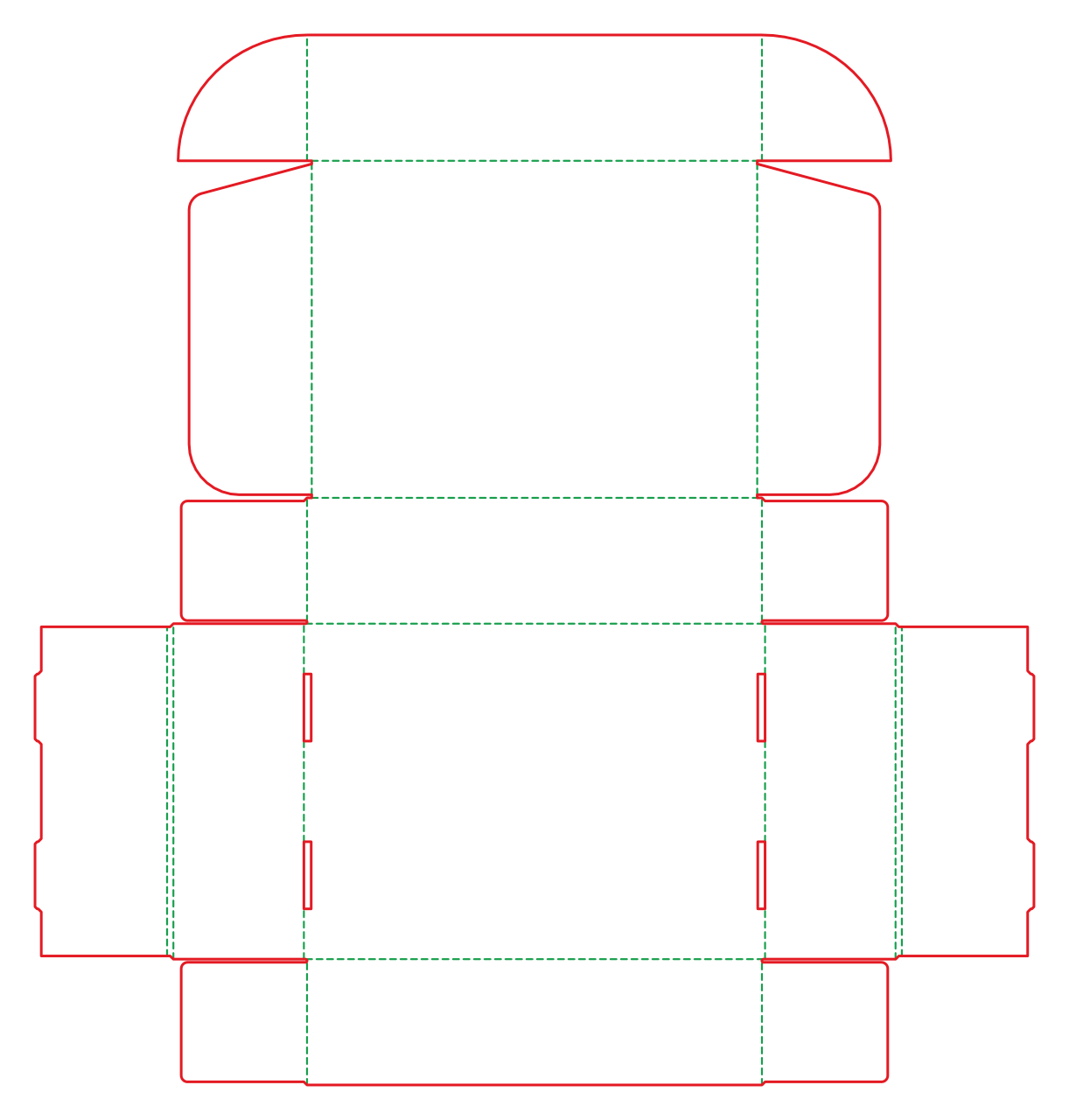
- Watch the drawing: where a wall folds back on itself, its two creases move apart as the board gets thicker.
- If the printer changes the board later, change the thickness and download again. Your sizes and the main creases stay put; only the details around the folds change.
Why it matters
- Your sizes don't change. They run crease to crease, and the thickness never moves those creases.
- Where a wall folds right back on itself, the dieline draws two creases twice the board's thickness apart, so both layers have room. Below 0.6 mm board one crease is enough.
- The lid, the slots, the lock tongues and how far each flap sits in from its fold all grow with the board, and so do the small angled cuts at inside corners.
- Tuck boxes, hang tab boxes, crash lock boxes and gable boxes are made for paperboard and thin flute, so they take a smaller range than the rest.
What each box takes
| Box | Thickness range | Boards in the list |
|---|---|---|
| Mailer box, Box with lid, Open tray, Drawer box, Cake box, Display box, Shallow mailer box | 0.3–7 mm |
|
| Tuck box, Tuck box with hang tab, Crash lock bottom box, Gable box, Cake box with handle, Popcorn box | 0.3–2 mm |
|
| Snap lock bottom box, Snap lock box with handle, Roof box, Flip top box, Angled top box | 0.3–7 mm |
|
| Shipping box, Tuck lid shipping box | 1–7 mm |
|
| Tissue box, Carry handle box | 0.3–0.8 mm |
|
| Tab lock mailer box | 1.5–3 mm |
|
| Shoe box | 1–3 mm |
|
| Pizza slice box, Slice tray | 0.4–1.6 mm |
|
| Pizza box | 1–3 mm |
|
| Octagon box | 0.3–1.6 mm |
|
| Roof box with handle | 0.3–3 mm |
|
| One bottle wine carrier, Two bottle wine carrier, Three bottle wine carrier | 0.4–1.6 mm |
|
| Beer box | 0.3–1.5 mm |
|
| French fries box | 0.3–1 mm |
|
Pillow box, Burger box: no thickness field. The board doesn't move any of its lines.
Not sure which board? Your printer is. Check the allowances with them before the die is made.
Next
Still stuck?